Le informazioni riguardanti i Frequency Monitoring Codes (FMC) sono state introdotte per la prima volta in AIP con con l’AIRAC A5/18, in vigore dal 21 Giugno 2018.
Information regarding Frequency Monitoring Codes (FMC) were for the first time introduced in AIP with with AIRAC A5/18, effective 21 June 2018.
/////
Generalità
Diciamo subito che lo spazio aereo coinvolto dalla citata implementazione è quello di classe G, all’interno del quale sono stati identificati alcuni settori FMC, associati ad un codice SSR e ad una frequenza da monitorare.
Allo scopo di prevenire e limitare le violazioni dello spazio aereo controllato, velivoli, elicotteri e apparecchi VDS avanzati equipaggiati con apparati radio, che operano all’interno di queste aree:
1) se stabiliscono contatto radio con il centro informazioni volo (FIC) e non diversamente istruiti dall’ATC, inseriranno il codice trasponder A2000;
2) se non stabiliscono il contatto radio con il centro informazioni volo (FIC) responsabile, devono inserire nel transponder Modo A il codice SSR assegnato a quello specifico settore e devono monitorare la frequenza indicata senza effettuare comunicazioni, a meno che contattati dall’ente ATS responsabile o se così previsto dalla normativa applicabile;
3) se stabiliscono il contatto radio con il centro informazioni volo (FIC) ed intendono monitorare, con il secondo apparato radio, la frequenza indicata per il settore inseriranno il codice SSR assegnato a quello specifico settore senza effettuare comunicazioni con lo stesso a meno che contattati dall’ente ATS responsabile o se così previsto dalla normativa applicabile.
General information
First of all, it must be specified that the airspace involved in this implementation is class G, within which some FMC sectors have been identified, associated with an SSR code and a frequency to be monitored.
In order to prevent and limit violations of controlled airspace, aeroplanes, advanced ultralight machines and helicopters equipped with radio equipment, within these areas, shall:
1) if they establish radio contact the flight information center (FIC) and not otherwise instructed by ATC, they will enter transponder code A2000;
2) if they do not establish radio contact with the responsible flight information center (FIC), they have to enter on the transponder A-Mode the SSR code assigned to that specific sector and they have to monitor the indicated frequency without communication, unless requested by the responsible ATS unit or if so provided by law;
3) if they establish radio contact with the flight information center (FIC) and intend to monitor, with the second radio apparatus, the frequency indicated for the sector they will enter the SSR code assigned to that specific sector without communication, unless requested by the responsible ATS unit or if so provided by law.
_____
Codice transponder A7000
Gli apparecchi VDS non avanzati dotati di transponder SSR e altri aeromobili non equipaggiati con apparati radio, pur non stabilendo il contatto radio con l’ente ATS responsabile, in quanto non destinatari di servizi del traffico aereo, potranno operare inserendo nel transponder il codice A7000, in applicazione del Regolamento (UE) ‘SERA’ e al Regolamento ENAC RAIT “Regole dell’aria”.
E’ bene sottolineare che l’inserimento del codice assegnato ad un settore non implica la fornitura di alcun tipo di servizio del traffico aereo idoneo a ricevere informazioni di volo e servizio di allarme, né autorizza ad entrare in uno spazio aereo controllato, se non in ottemperanza alle procedure in vigore.
Transponder Code A7000
Non-advanced ultra light machines equipped with SSR transponder and other aircraft not equipped with radio, even if they do not establish radio contact with responsible ATS unit because they are not users of air traffic control services, may operate by entering code A7000 on the transponder, in application of the (EU) ‘SERA’ Regulation and the ENAC RAIT “Regole dell’Aria”.
It should be specified that the entering the code assigned to a sector does not imply the provision of any type of air traffic service for the provision of flight information and alerting services, nor does it authorise entry into controlled airspace, if not in compliance with applicable procedures.
_____
FMC e controllo del traffico aereo
Il controllore del traffico aereo che osserva un traffico sconosciuto che ha inserito un FMC che sta per entrare o che sia già all’interno del proprio spazio aereo controllato senza autorizzazione è consapevole del fatto che tale traffico sia:
– in ascolto sulla frequenza pubblicata se ha inserito il codice FMC; oppure
– in contatto con il FIC di competenza per la fruizione dei servizi ATS se ha selezionato il codice transponder A2000.
In questo modo, può tentare di stabilire in maniera tempestiva una comunicazione bilaterale allo scopo di fornire le appropriate informazioni, istruzioni e/o autorizzazioni.
La relativa comunicazione conterrà elementi quali:
1) codice SSR;
2) posizione della traccia radar del traffico sconosciuto rispetto ad uno specifico punto di riferimento facilmente identificabile dal pilota; 3) livello/altitudine osservati sul Modo C, qualora disponibili;
4) direzione del volo osservata;
5) nominativo derivato dal Modo S, se disponibile.
______
Il pilota che sospetti, in base alle informazioni ricevute, che l’aeromobile al quale la comunicazione si riferisce sia proprio il suo, dovrà rispondere tempestivamente.
Una volta stabilita una comunicazione bilaterale, per avere la certezza che si tratti effettivamente del traffico in questione:
– se in contatto con il settore ATC, il controllore provvederà alla sua identificazione radar e fornirà istruzioni, avvisi e/o informazioni, come appropriato;
– se in contatto con il FIC, potrà essere trasferito in contatto con il settore ATC.
Il codice SSR e l’eventuale informazione del modo C associata rimangono non verificati finché ATC e pilota non applicano le appropriate procedure di identificazione e verifica.
////
FMC and Air Traffic Control
ATCO observing an unknown traffic, squawking an FMC, that is about to enter or is already within its controlled airspace without authorization is aware of the fact that such traffic is:
a. listening to the published frequency if he entered the FMC code ; or
b. in contact with the FIC responsible for ATS If he selected the transponder code A2000.
ATCO may attempt to establish a bilateral communication in a timely manner in order to provide the appropriate information, instructions and/or authorizations.
_____
Transmissions will contain:
1) SSR code;
2) position of the unknown traffic, referred to a familiar way point for the pilot;
3) level/altitude observed on C-Mode, if available;
4) direction of the observed flight;
5) S-Mode derived callsign, if available.
______
A pilot monitoring the frequency who suspects, on the basis of the information provided, that theirs is the aircraft being referred to, should promptly answer accordingly.
Once a bidirectional communication has been established, to confirm flight’s identity:
– if the aircraft concerned is on ATC frequency, the controller will provide his radar identification and issue the suitable instructions or advice;
– if the aircraft concerned is on FIC frequency, it will be instructed to contact the adequate ATC Unit.
_____
The code and any associated C-Mode pressure-altitude reporting data are considered to be unverified, until an appropriate identification procedure between ATC Unit and aircraft has occurred..
_______
Settori FMC
Ma veniamo ai settori FMC istituiti nello spazio aereo italiano, specificando che, per ognuno di essi, i limiti verticali devono essere intesi come segue:
– limite verticale inferiore: SFC
– limite verticale superiore: corrisponde al limite verticale inferiore degli spazi aerei controllati sovrastanti (CTR, TMA, CTA, rotte ATS)
FMC Sectors
We will now analyse the FMC sectors established in Italian airspace, specifying that, for each of them, vertical limits are to be intended as follows:
– lower vertical limit: SFC
– upper vertical limit: corresponds to the lower vertical limit of the controlled airspaces overlying the area (CTR, TMA, ATC, ATS routes)
______
Milano FMC Areas
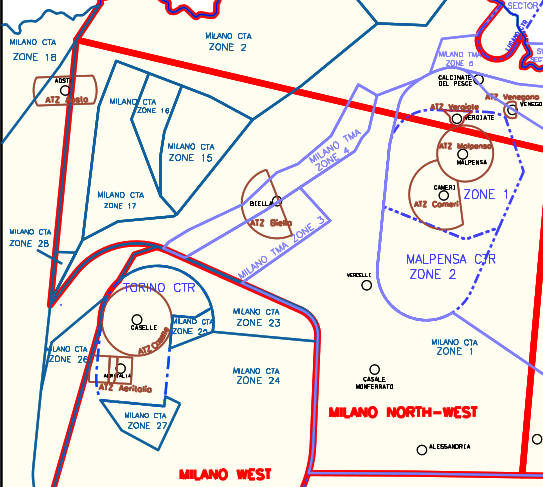
MILANO NORTH-WEST FMC Area
Se non in contatto con Milano FIC / If not in contact with Milano FIC
Monitoring Frequency: 134.425 MHz (APP Milano Radar)
Frequency Monitoring Code: A4610
Nota: La CTR di Malpensa non è inclusa nei limiti laterali e verticali di questo settore.
Remark: Malpensa CTR is not included in the lateral and vertical limits of this sector.
(informazioni aggiornate alla variante AIRAC A6/25, in vigore dal 12 Giugno 2025)
_______
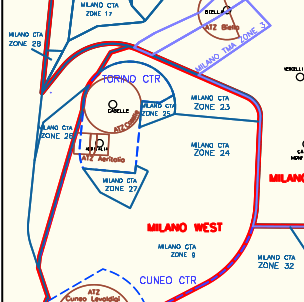
MILANO WEST FMC Area
Se non in contatto con Milano FIC / If not in contact with Milano FIC
Monitoring Frequency: 129.275 MHz (APP Milano Radar)
Frequency Monitoring Code: A4614
Nota: Le CTR di Torino e di Cuneo non sono incluse nei limiti laterali e verticali di questo settore.
Remark: Torino and Cuneo CTR are not included in the lateral and vertical limits of this sector.
_______
MILANO NORTH-EAST FMC Area
Se non in contatto con Milano FIC / If not in contact with Milano FIC
Monitoring Frequency: 126.300 MHz (APP Milano Radar)
Frequency Monitoring Code: A4611
Nota: Le CTR di Linate, Bergamo e Piacenza non sono incluse nei limiti laterali e verticali di questo settore.
Remark: Linate, Bergamo and Piacenza CTR are not included in the lateral and vertical limits of this sector.

_______
MILANO EAST FMC Area
Se non in contatto con Milano FIC / If not in contact with Milano FIC
Monitoring Frequency: 135.900 MHz (APP Milano Radar)
Frequency Monitoring Code: A4613
Nota: La CTR di Verona non è inclusa nei limiti laterali e verticali di questo settore.
Remark: Verona CTR is not included in the lateral and vertical limits of this sector.

_____
MILANO NORTH FMC Area
Se non in contatto con Milano FIC / If not in contact with Milano FIC
Monitoring Frequency: 126.750 MHz (APP Milano Radar)
Frequency Monitoring Code: A4612
Nota: La CTR di Malpensa non è inclusa nei limiti laterali e verticali di questo settore.
Remark: Malpensa CTR is not included in the lateral and vertical limits of this sector.

_______
_______
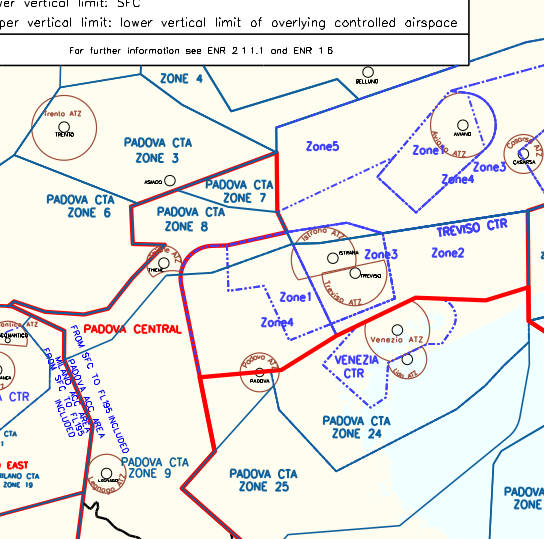
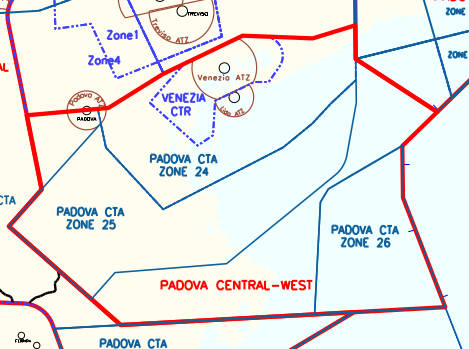
PADOVA CENTRAL FMC Area
Se non in contatto con Padova FIC / If not in contact with Padova FIC
Monitoring Frequency: 120.725 o 134.750 MHz (Padova ACC)
Frequency Monitoring Code: A4777
_______
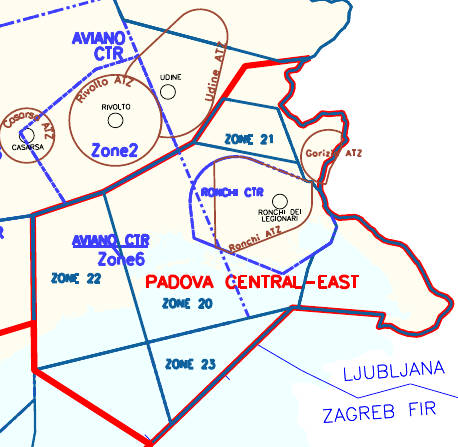
PADOVA CENTRAL EAST FMC Area
Se non in contatto con Padova FIC / If not in contact with Padova FIC
Monitoring Frequency: 119.175 MHz (Padova CE0)
Frequency Monitoring Code: A4776
Nota: La CTR di Ronchi non è inclusa nei limiti laterali e verticali di questo settore.
Remark: Ronchi CTR is not included in the lateral and vertical limits of this sector.
_______
PADOVA CENTRAL WEST FMC Area
Se non in contatto con Padova FIC / If not in contact with Padova FIC
Monitoring Frequency: 118.900 MHz (Padova SEO)
Frequency Monitoring Code: A4775
Nota: La CTR di Venezia non è inclusa nei limiti laterali e verticali di questo settore.
Remark: Venezia CTR is not included in the lateral and vertical limits of this sector.
______
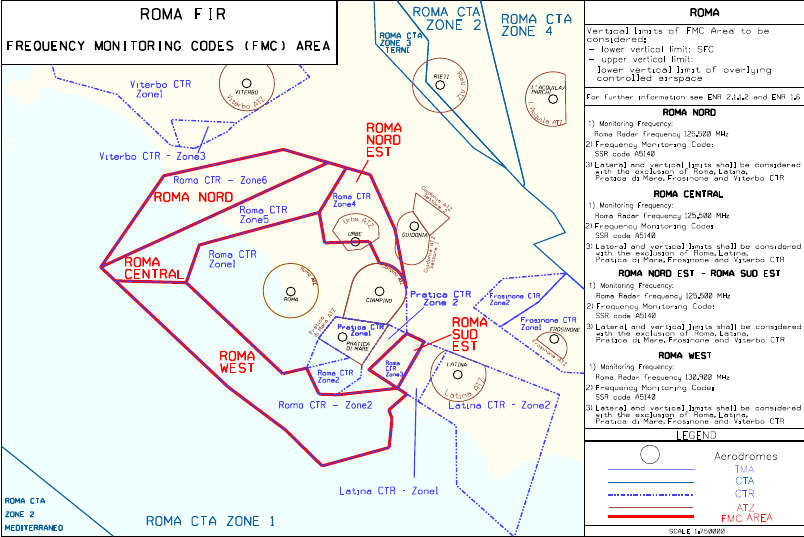
ROMA FMC AREAS
ROMA NORD/ ROMA CENTRAL/ROMA NORD-EST/ROMA SUD-EST
Se non in contatto con Roma FIC / If not in contact with Roma FIC
Monitoring Frequency: 125.500 MHz (Roma Radar)
Frequency Monitoring Code: A5140
Nota: Le CTR di Roma, Latina, Pratica di Mare, Frosinone e Viterbo non sono incluse nei limiti laterali e verticali di questo settore.
Remark: Roma, Latina, Pratica di Mare, Frosinone e Viterbo CTR are not included in the lateral and vertical limits of this sector.
/////
ROMA WEST
Se non in contatto con Roma FIC / If not in contact with Roma FIC
Monitoring Frequency: 130.900 MHz (Roma Radar)
Frequency Monitoring Code: A5140
Nota: La CTR di Roma non è inclusa nei limiti laterali e verticali di questo settore.
Remark: Roma CTR is not included in the lateral and vertical limits of this sector.
(Informazioni aggiornate alla variante AIRAC A7/26, in vigore dal 9 Luglio 2026)
(Information updated at AIRAC A7/26, effective from July 9, 2026)
______
ALGHERO/OLBIA FMC Area
Se non in contatto con Roma FIC / If not in contact with Roma FIC
Monitoring Frequency: 125.950 MHz (Roma Radar)
Frequency Monitoring Code: A5137
Nota: Le CTR di Alghero ed Olbia non sono incluse nei limiti laterali e verticali di questo settore.
Remark: Alghero and Olbia CTR are not included in the lateral and vertical limits of this sector.

_______
_______
_______
